The first fill-up in a Korean rental car comes with a few practical problems. The fuel names are in Korean, some pumps are self-service, and prices vary from station to station. A free public price site, Opinet, answers most of it, though it’s in Korean too.
This guide covers the Korean fuel names, what Korea’s safety rules require at self-service pumps, how to check prices on Opinet and what a trip is likely to cost.
How we checked
Prices come from Opinet (오피넷), the fuel price service run by the Korea National Oil Corporation, a public corporation. We checked its nationwide averages on October 22, 2026. The pump rules come from Annex 13 of the Enforcement Rule of the Dangerous Substances Safety Management Act (위험물안전관리법 시행규칙), in the version in force since July 1, 2026.
The fuel economy example uses Hyundai Korea’s official rating for the new Avante, and the rental section uses Lotte Rent-a-Car’s English page. We didn’t use prices or claims from news reports or station chains.
Fuel names in Korean
Opinet uses these names for road fuels. The averages include VAT.
| Fuel | Korean | Avg. price (won/L) |
|---|---|---|
| Regular gasoline | 휘발유 (보통휘발유) | 1,855.87 (Oct 22) |
| Premium gasoline | 고급휘발유 | 2,397.46 (Oct 21) |
| Diesel | 경유 (자동차용경유) | 1,842.47 (Oct 22) |
| LPG (autogas) | LPG | 1,143.84 (Oct 22) |
The premium figure comes from Opinet’s daily statistics page, which showed October 21 as its latest day. The others are the averages on Opinet’s front page on October 22.
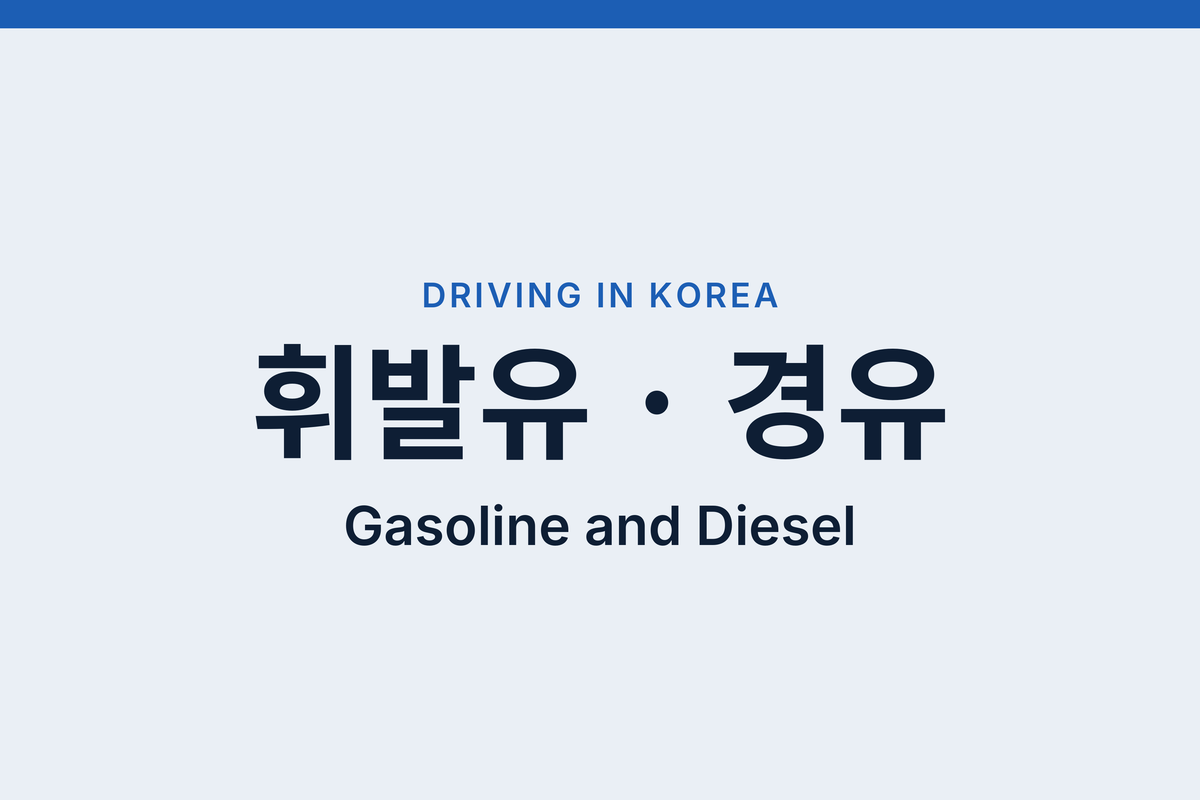
Diesel is 경유 (gyeong-yu) and gasoline is 휘발유 (hwi-bal-yu). The two words look nothing like their English names, so learn them before your first stop. If you’re not sure which fuel your rental takes, ask at pickup.
Rules at every gas station
Section II of Annex 13 requires every gas station to post a sign reading 주유중엔진정지, “engine off while refueling,” in black on yellow. It must also post a sign marking the station as a no-smoking area. Switch the engine off before you start.
Self-service pumps
Korea has both full-service and self-service stations. Opinet’s station search can filter for full-service (일반) or self-service (셀프) stations, so you can choose before you arrive. At a full-service pump, an attendant fills the car for you.
Section XV of Annex 13 sets the standards for self-service pumps. Among them:
- The nozzle stops automatically when the tank is full.
- If a nozzle can be latched open, fueling must stop automatically when it leaves the filler neck.
- The pump must have a structure to prevent mixing up gasoline and diesel.
- Each session is capped at 100 liters and 4 minutes for gasoline, and 600 liters and 12 minutes for diesel.
Signs next to a self-service pump must say customers can fill up themselves and show where to stop the car. Instructions and the fuel type must be shown near the hose. Where a station also has staff-only pumps, those must be marked as not for customer use.
The station must have a monitoring booth that can see every self-service pump. The booth needs a control that stops fuel to all of them and a speaker system to give customers instructions.
The misfuel safeguard is a requirement for the equipment, not a guarantee, so read the nozzle label anyway. If you think you’ve put in the wrong fuel, tell the staff and call your rental company before you drive off.
Checking prices with Opinet
Opinet’s website is in Korean. Its front page shows today’s nationwide average for gasoline, diesel and LPG, and averages by province.
The station search (싼 주유소찾기, “find a cheap station”) lists stations in an area with their prices. It can also filter for extras such as a car wash, a convenience store or stations open 24 hours. On October 22, 2026, the lowest gasoline price on the front page was 1,765 won and the highest was 2,549 won, so the gap between stations can be large.
Opinet also has a menu where rule violations by stations are made public (불법행위공표). We didn’t review those listings, but you can check them before choosing a station.
How much will a trip cost?
Divide the distance by the car’s fuel economy to get liters, then multiply by the price. For example, a 400 km drive in a car rated at 14.3 km/L, at 1,855.87 won a liter, comes to about 51,900 won by our calculation, rounded to the nearest 100 won.
The 14.3 km/L figure is the official Korean combined rating for the new 2.0 gas Avante on 16-inch wheels. Our guide to the new Avante and the Elantra has the rest of its specs. Official figures come from a standard test, so real driving can differ.
Trip fuel cost estimator
Enter your distance and your car’s fuel economy. The price starts at Opinet’s nationwide average for the fuel you pick, and you can change it to the price at your station. Changing the fuel resets the price.
Default prices: Opinet (Korea National Oil Corporation) nationwide averages shown on October 22, 2026, including VAT: regular gasoline 1,855.87, diesel 1,842.47 and LPG 1,143.84 won per liter. Prices change daily. The default 14.3 km/L is the official Korean combined rating for the 2.0 gas Hyundai Avante on 16-inch wheels. Results are estimates, not quotes.
The estimator works in km/L because that’s how Korean ratings are published. If you think in US mpg, our Kia K8 guide has a converter that turns km/L into mpg.
LPG and electric cars
Opinet lists LPG separately from gasoline and diesel, and its station search has a separate tab for LPG filling stations (충전소). If your rental runs on LPG, plan your stops with that tab. The Hyundai Grandeur and the Kia K8 are both offered with LPG engines in Korea, as our list of Korea-only Hyundai and Kia models shows.
LPG filling stations come under a separate gas safety law, so the gas station rules above don’t describe them. If you’re driving an electric car, our guide to EV charging in Korea covers chargers and rates.
Filling up a rental car
How full the tank should be when you return the car, and what you pay if it isn’t, depends on your rental contract. When we checked Lotte Rent-a-Car’s English rental page on October 9, 2026, it said fuel charges after a key-drop return are billed to your registered card.
Read the fuel section of your own contract before you set off. Our guide to renting a car in Korea covers what the law requires of rental companies and what comes from their own terms.
Before you pull in
- Know your fuel: 휘발유 for gasoline, 경유 for diesel.
- Check the station type and price on Opinet if you have time.
- Turn the engine off before fueling.
- At a self-service pump, read the nozzle label before you start.
- Keep your rental contract’s fuel rule in mind before the last fill-up.
Last checked: October 22, 2026. Sources: Opinet, Korea National Oil Corporation (front-page averages for October 22, 2026, daily average price statistics for October 21, 2026, and station search; in Korean); Enforcement Rule of the Dangerous Substances Safety Management Act, Annex 13, sections II and XV (Korean Law Information Center, in Korean); Hyundai Korea all-new Avante price list (fuel economy); Lotte Rent-a-Car English rental page (checked October 9, 2026, for our rental guide).
Leave a Reply